

Training, Consulting, and Speaking for Neurodiversity Affirming Therapists
It can feel isolating to be a neurodiversity affirming therapist in such an ableist world. You’re working hard to unlearn ableism and sometimes it feels like the rest of the world is running headlong into ableist myths.
If you’re a neurodivergent therapist yourself this can add a whole other layer of distress!
You go to trainings, consultations, summits and still find people working from the deficit model, the medical model.
That’s where I come in!
I offer what you deserve: consulting and training that centers affirmation and access, not deficit.
Neurodiversity Affirming Therapy: My Take
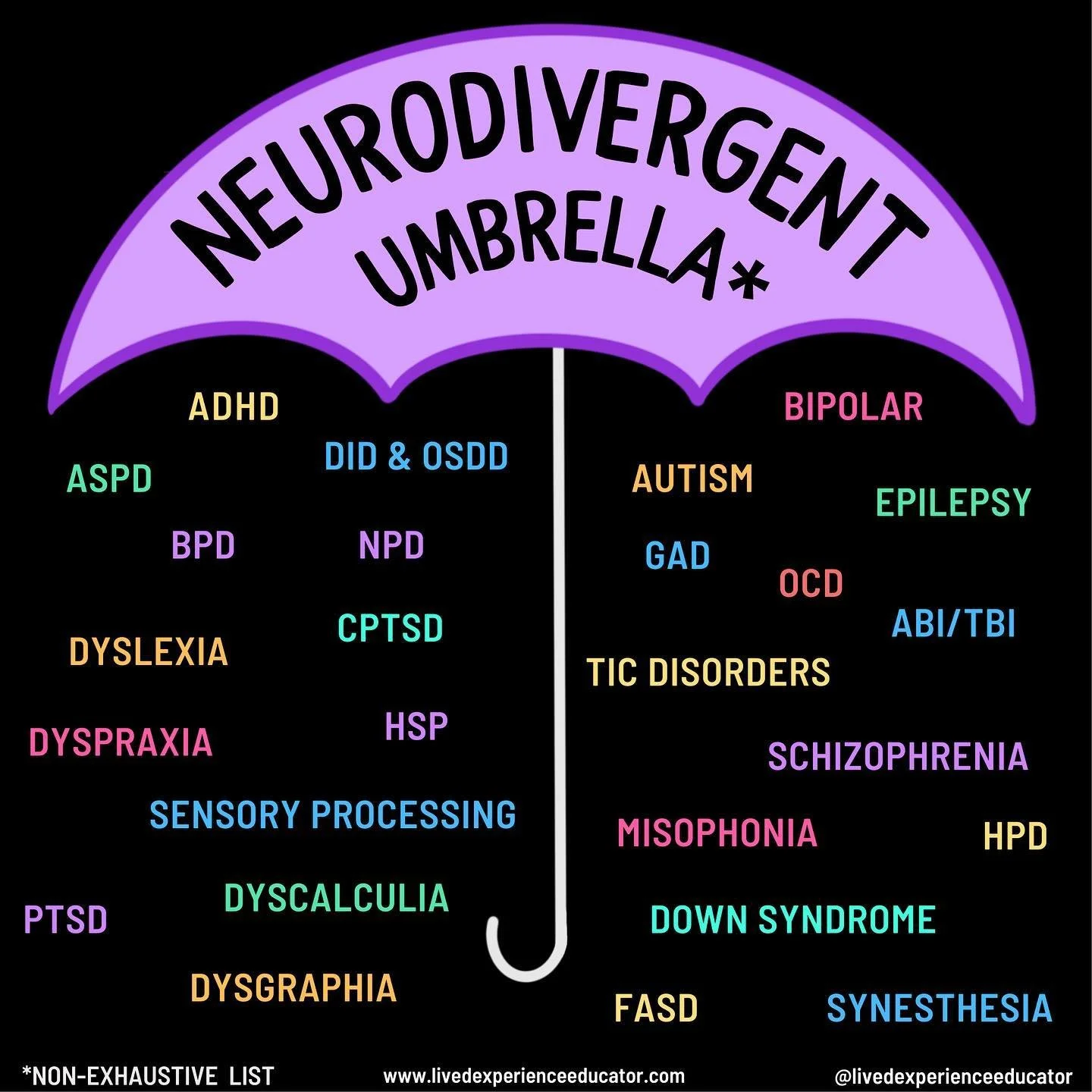
The neurodiversity paradigm acknowledges the differences (not deficits or disorders) of all brain and nervous system functioning.
It says “no” to a hierarchy of ways of thinking, knowing, doing, being, and experiencing.
There is nothing to “fix” about people in this model - whether innate or acquired, nature or nurture. All body-minds are welcome here!
This feels easy to understand and agree with, hell “unconditional positive regard” is a hallmark taught in all grad programs. It can be harder to put into practice. Not because you don’t believe it but because our society is so gum-stuck in ableist ways of being.
What it looks like in the therapy room.
An office that centers universal design principles to ensure accessibility.
Flexibility
Equitability
Simple and intuitive
Tolerant to error.
An understanding that there is no one size fits all solution.
An interest in the needs and preferences of the specific client in front of you.
A willingness to name systems such as ableism, racism, capitalism, colonialism, and more that intersect to create a body-mind hierarchy.
What it looks like in your therapy room is different than what it will look like in mine.
What it looks like in your therapy room will even change hour to hour, session to session.
Moving from knowing to doing is the hard part. Society will tell you you have to do it alone, only showing up in spaces once you have it perfect.
Not here, not with me.
I welcome imperfection. I recognize that this work is seldom actually done in isolation, I certainly have not done so in isolation.
I will bring what I have learned from formal sources (such as books, research, trainings, consulting) and my own lived experience as a neurodivergent human with multiple acquired and innate neurodivergences.

"Neurodiversity is not just a concept—it is a call to action against oppression."
— Kassiane Asasumasu
Why Therapists Struggle
You're on the neurodiversity affirming path. You believe in this work. So why does it still feel so hard to practice it?
What I hear from therapists:
Training left you high and dry.
Grad school glossed over concepts related to oppression or skimmed the very top layer.
There was still a supremacy built into the program itself so they were never going to teach you how to dismantle that in thought or action.
Even after grad school, trainings in individual modalities are still aiming at a “right” way for clients to function.
What’s worse? If they did explore neurodiversity they used it interchangeably with autism and maybe ADHD.
This leaves out heaps of neurodivergent people and reinforces the very hierarchy the neurodiversity paradigm seeks to unseat!
Isolation creeps in.
There are some spaces that highlight neuroaffirming care, though a lot are autism and ADHD focused and may leave out entire swaths of neurodivergent people.
Worse, lots of therapist spaces (facebook groups, listservs, trainings, summits) are working from the deficit medical model. They want you to punish your client into “normalcy”.
It can feel like you’re completely alone.
Internalized ableism is pervasive and impactful.
When clients come in, sometimes they’ve been affected by internalized ableism.
They want to find ways to be more “neurotypical”, more accepted by society at the cost of their own authenticity.
You know that client autonomy is hugely important and at the heart of neuroaffirming care and yet sometimes it’s based in internalized ableism.
Finding the balance, creating a nonjudgmental space where a client can also learn and confront those ableist beliefs is essential!
And when you’re neurodivergent yourself?
You’re not just unlearning ableism and learning the neurodiversity affirming paradigm. You’re healing from it.
The ways you’ve been pathologized and even maybe pathologize yourself now impact your work every day!
Getting consultation that is not neurodiversity affirming hurts all the more (rejection sensitivity dysphoria anyone?)
What I Offer
-
Live or self-paced training that actually helps you move from knowing to doing. We'll cover:
How to adapt your favorite modalities to be truly affirming
What to do when a client's goals are rooted in internalized ableism
Intake forms, documentation, and policies that center access
No shame. No "you should already know this." Just practical, actionable learning.
-
You're running a practice with multiple clinicians. You want to align your policies, supervision, and culture with neurodiversity affirmation – but where do you even start?
I'll work with you on:
Staff training and ongoing support
Affirming intake processes and client materials
Supervision frameworks that don't replicate the deficit model
Hiring and supporting neurodivergent staff
-
You need a speaker who can hold the room – clinical enough for therapists, political enough for the moment, and real enough to actually land.
I offer keynotes, workshops, and panels on topics including:
Neurodiversity affirming practice beyond the basics
The intersection of neurodiversity and other liberatory frameworks
Internalized ableism in the therapy room
Building access into everything you do
You might also like…
Podcast Episodes
We have a brand new logo to accompany this week’s episode! We’re explaining why that is, what the new flag by AceinGrace means, and we’re answering some questions about life on the asexuality spectrum. We’re covering if hormones are the reason someone’s asexual, what to do about it, and how to navigate uncomfortable Public Displays of Affection from friends.
This episode explores ADHD, medication options, and navigating healthcare as a college student. We share insight about diagnosis, medication types, and advocating for support at college - and with your doctor!
Disclaimer: We are not medical professionals! Do some more research and touch base with your provider, please.
We’ve been asked to give our top tips for heat intolerance for autistic and ADHD folks! Join us to hear what we’d suggest to stay cool and how to survive summer. Curious about how to start your very own EveryFans (or what that is?) Listen to find out!
We’re talking all about how to be a better ally to asexual and autistic people! We’re also debunking even more myths and stereotypes about autism. Wondering about what counts as a special interest? Or what the "broader autistic phenotype" or "female autism" really means? Join us to hear more!
In this episode, we’re examining how PDA & BPD can impact romantic relationships. If you’re wondering how to avoid triggers, feel loved, and build connection with your partner, this episode is for you!
In this episode, we are busting the most common autism myths that still circulate today! Whether you are an autistic adult, a parent of a newly diagnosed child, a therapist like us, or an educator, understanding the truth about autistic individuals is crucial.
If submission has ever felt like a demand and triggered your PDA, this week’s episode might resonate with you! We’re answering if you’re a “bad sub” if you’re a PDAer, how to navigate explaining your nervous system to a partner, and why kink is healing. We explore a few ways people can heal from trauma and feel empowered by kink. Join us!
Have you ever wondered where that praise or degradation kink stems from? Or if it's possible to hyperfocus on kink and fetishes? Let's talk about it on this week's episode of Aces Up Your Sleeve! We're talking about the importance of meeting your needs, libido discrepancy, differences of opinion when it comes to kink, and more!
Ready to hear all about chronic pain, illness, and being autistic? We're ready to talk about it! Join us for a raw and real conversation about what it's like to navigate these challenges, especially when the onset is pretty sudden.
To wrap up our mini-series on Teens this week, we’re mostly talking to parents about how to support their autistic and ADHD teenagers! We’re joined by Jamie Roberts, an AuDHD LMFT, who specializes in supporting teens and has published two books for ND teens. We’re answering how to know when they need down time, the importance of recharging, and when you ought to be concerned. We’re also discussing why neurodivergent teens may not seem “motivated” toward independence these days - and how to support them.
This week's episode involves us exploring the complex topics of self-harm, self-stimulatory behaviors, and support strategies for autistic and ADHD teens. (We definitely talk directly about all of these topics, so feel free to skip this one if you need to!) We're sharing about harm reduction, stigma, communicating with parents and guardians, and ways to support teens compassionately.
Welcome to season 2! We're starting off with a small series on Autistic & AuDHD Teens in light of our upcoming GEMS Neurodiversity Summit: Autistic + ADHD Teens event in May. For today’s topic, we’re discussing success during teen years and answering listener questions.
You'll get some school accommodation ideas, autistic-teenager-friendly job ideas, and more!
Our season finale is a special one- we’re participating in the 4th annual Podcasthon! This week, over a thousand podcasts are highlighting a charity of their choice and we’re choosing to support the Black Trans Travel Fund! Tune in to hear about why we chose them, what they’re all about, and how to support them.
We’re also answering questions regarding the intersections of autism, race, sexuality, and gender. How do you know if you’re masking or code-switching? Whose parent gets to decide if you’re trans or if it’s somehow “just your autism”? We weigh in on these topics and provide some supportive ideas and words of wisdom.
In this week’s episode of Aces Up Your Sleeve, we are exploring the complexities of “coming out” as autistic, with a focus on the decision-making process regarding disclosure to family and medical professionals. We take the nuances of family dynamics into consideration and examine the potential risks and benefits of sharing your neurotype, as well as the importance of finding supportive medical providers! Listen to learn why we prioritize self-advocacy, safety, and the significance of community support for autistic folks.
This week is all about adult autistic meltdowns on the Aces Up Your Sleeve podcast. We discuss our personal experiences with meltdowns, the differences between autistic and Borderline meltdowns, and the importance of understanding your own unique sensory triggers. We talk about the need for community support, coping strategies, and the significance of meeting basic needs to help manage overwhelming situations. We also dispel some misconceptions about meltdowns and highlight the importance of finding the right therapeutic support- it is out there!
This week on Aces Up Your Sleeve, we’re joined by guest Patrick Casale, LMHC, to discuss neurodivergent entrepreneurship! If you’re autistic and struggling at work, AuDHD with a million ideas and interests but aren’t sure how to start, or neurodivergent and needing a change in your career, this episode is for you. We touch on burnout, juggling friendships, the struggle of finishing a project, and more! We’re highlighting lived experience and giving real ideas to help you navigate these tricky topics.
On Hit Me Again, our exclusive paid bonus content with our guest Patrick Casale, LMHC, we answer whether or not autism plays a role in running your own business. We’re talking more about burnout, communication, and the importance of community! Find that in the "Hit Me Again" collection here on Patreon.
If you're feeling helpless or hopeless right now, you're not alone- and there are things we can do (as ADHDers and autistic folks) to help make movement and change! We're answering questions this week about advocacy, activism, and volunteering in our communities. We discuss different roles we can play based on our strengths and weaknesses, ways to find places to volunteer, and the differences between visibility and change-making. Listen in for some fresh insight and check the show notes for resources!
How do autistic and ADHD people make romantic Valentine’s Day plans? We’re covering that on this week’s episode of Aces Up Your Sleeve! Whether you’re throwing a party with friends or trying to take your partner out on a date, we’re giving our ideas on how to make it an unforgettable time. Is it the thought that counts or should you snag inspiration from movies?
Need to brush up on your Neurodivergent Flirting Skills? Flirting can feel like a complex game with no clear rules, especially in the context of modern dating. In the latest episode of the Aces Up Your Sleeve podcast, we explore the nuances of flirting, how to recognize when someone is interested, the challenges of interpreting intentions, and how to approach flirting in a more effective way for autistic folks! You’re right at home if you feel like you’re playing a game that’s outside of your control. Join us to hear what to do about that.
Whether you’re a millennial or not, you may be wondering why so many millennials are suddenly realizing they’re autistic! We attempt to answer that, as well as provide insight about autistic millennials in general and what similarities we have (if any.) Is it a Tiktok Diagnosis, a trend, or deep self-realizations?
We discussed being autistic at work in this episode! How do you move up the corporate ladder? Should you even try? What makes a good supervisor? We share our tips and tricks for supervising people, carving out roles that work with your strengths, and more! If you’ve ever wondered how autistic people supervise or manage, this episode will answer those questions.
We’re letting you in on a little known secret: Where to find autistic therapists and community! It shouldn’t be a secret but it’s tough to know where to look to find others like yourself- and us. We discuss the importance of community, tips to getting closer to other autistic therapists, and how to start a community space if you feel up to it.
For Episode 12, we're joined by B Lourenco, a Licensed Mental Health Counselor, to discuss the complexities of Pathological Demand Avoidance (PDA) and its impact on parenting and relationships. We explored the nuances of PDA, the challenges faced by parents of PDA children, communication and collaboration strategies, and the importance of repair in relationships. B shares insights from her personal and professional experiences, emphasizing the need for understanding, autonomy, and playful communication in navigating the unique dynamics of PDA!
Just in time for a couple of holidays, we’re talking all about being autistic and giving & receiving gifts! If you’re someone who struggles with giving the “right” reaction to presents or with knowing what gifts to get people, you’ll find some helpful tips and tricks on this episode. We’re also giving you some ideas for how to create new traditions, accommodate yourself, and set boundaries around holidays and gift exchanges.
We've been asked to talk about how to prepare (emotionally) for an autism assessment and the results, so we're giving you our favorite tips. We also cover how to prepare yourself for potential second opinions and how to secure an affirming evaluator in the first place. If you've ever wondered if it's worth it to get diagnosed, this episode (and our Patreon bonus content) are for you!
Are you ready to talk about demisexuality? We’re helping listeners explore whether or not they may be autistic, demisexual and/or kinky! We debunk the “pillar” of a romantic relationship, talk about the impacts of autistic masking on desire and connection, and explore other ways to connect intimately with people to get your needs met. If you’ve been wondering how to reconcile being on the asexuality spectrum AND being kinky, this is the episode for you!
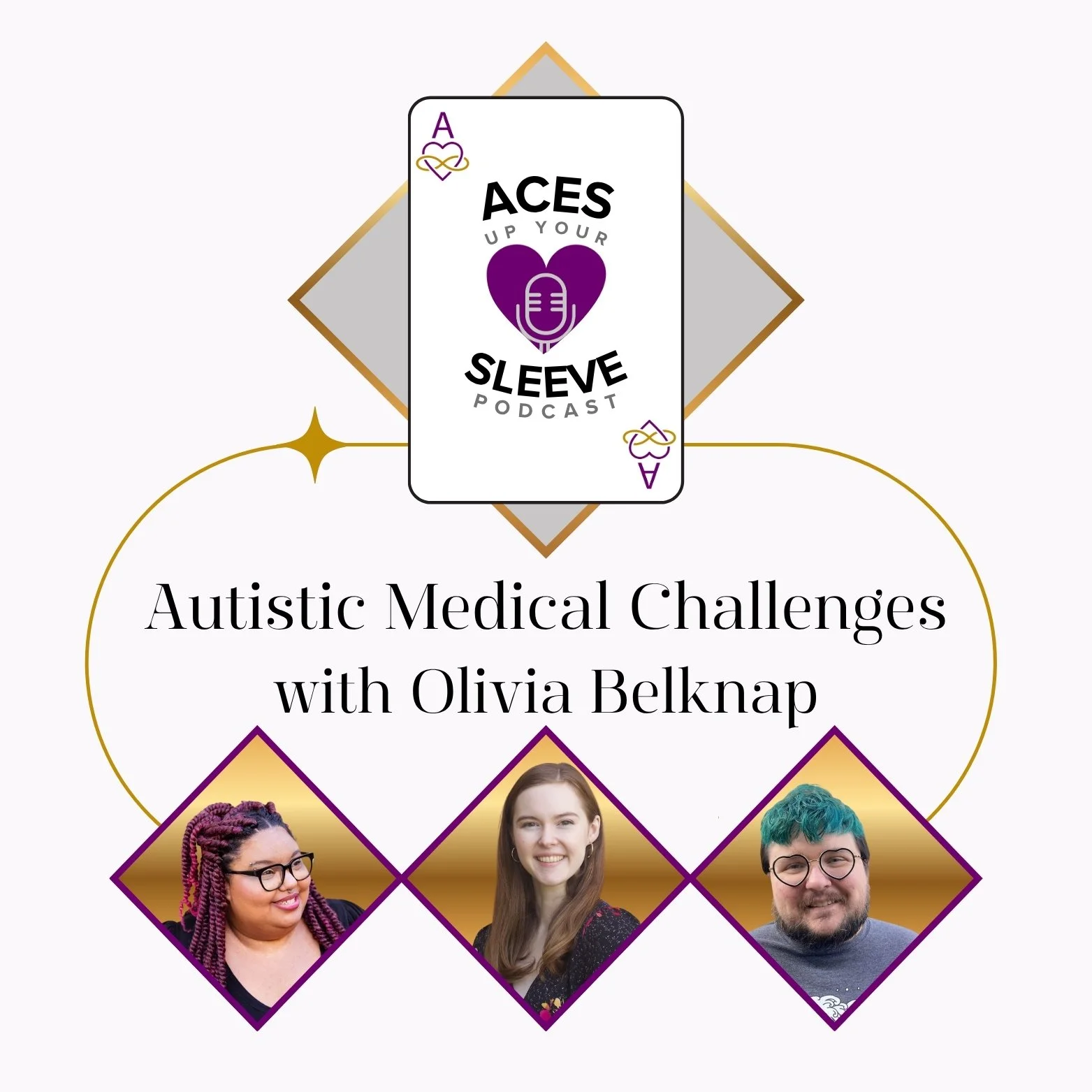
Join Sabrina, Kade, and our guest Olivia Belknap, AMFT, as we discuss autistic medical challenges, medical self-advocacy, and more! Many of us are more sensitive to meds, need support conveying what we mean to providers, struggle with providers who think we’re malingering or exaggerating our experiences, and could use extra tips in navigating complex medical systems. We’re sharing our tips and tricks, as well as validating that it’s not always an “us problem”! Long COVID, autonomic struggles, Mast Cell Activation Syndrome, and other common health challenges for autistic people are discussed.

In the 7th episode of the Aces Up Your Sleeve podcast, we discuss the complexities of Family Meal Time, especially for folks with dietary restrictions and sensory needs. We’re highlighting the importance of self-advocacy, communication, and setting boundaries to navigate family dynamics during the holidays. The conversation also touches on coping strategies for dealing with uncomfortable comments from family members and the significance of prioritizing mental health over traditional expectations. We cover this for both teens and adults. Join us to hear all of our tips, tricks, and ideas to navigate holiday meals with family!
Our fifth episode is all about navigating Competing Sensory Needs! Neurodivergent sensory needs are real and valid - so how do we support each other when ours all differ? We’ll be sharing about the importance of compromise, strategic communication, and understanding sensory needs. We go further than just different sensory needs and talk about varied “love languages” and communication needs too, providing ideas for communication techniques to support each other. Whether it’s family, friends, a partner, or an extracurricular group, we’ve got you covered!
Blogs
As I sit in Maine at the Doubt Yourself Do It Anyway Summit, I keep hearing the same thing over and over:
Everything is hard, I just want to connect to people, I need help, and most importantly the future of small group and individual therapy practices lives in relationships.
And I keep thinking about what I see get in the way and to be honest y’all, some of us find it hard to be held accountable.

The book White Fragility blew up a few years back and got everyone investigating “Why It’s So Hard for White People to Talk About Racism”
But here’s the kick, it was by a white person.
It didn’t take long for people to start to critique the book, the premise, the author. I’ll be honest I didn’t read it…I don’t read books on racism by white people ¯\_(ツ)_/¯
But here’s what I want to talk about today, while the book was popular among who you would think it would be….the phrase seems to have become popular with everyone.

I wanted to share my diagnosis story, my borderline diagnosis story.
I do want to share a few content warnings for this one: I will be discussing emotional ab*se, emotional n*gl*ct, self h*rm, and su*c*dal ideation and actions (not in any great detail). Please care for yourself however you need, take breaks or skip this one entirely if you need to!
I guess in some ways, due to the nature of BPD and the attachment traumas we so often see at the base of them, my diagnosis is a little bit of my life story. Don’t worry reader, I won’t take you through every grueling detail (I don’t even remember them all lol), but I promise it will pay off. I’ll give you a little teaser.
Language is alive and impacts pretty much everything we do. How we talk about things, the labels we use, they matter even when they are messy and ever-changing. I began using BBA and BBIA instead of BIPOC several years ago. Here’s why.
I learned silence early.
As a queer, fat, Black, multiply neurodivergent woman, I learned that my voice was too much. Too loud. Too honest.
Even when I whisper, even when I covered my words in flowers and acquiescence, even sometimes when I was silent I was still too loud.
I’ve been the bad guy. And I’ve made others into one too. It’s a tempting and societally pressured response to many feelings of discomfort.
The problem with bad guys
As much as life might be easier, more comfortable, if there was a villian it leads us nowhere. We get to point the finger. “If they would just change everything would be better”. It halts real progress.

So, I started this business to try to support people in my communities and people who want to support people in my communities. All the time, especially when talking about business type shit (like marketing and “content pillers” or whatever) people talk about “what is your why”.
I sometimes have a hard time nailing down just one why. It’s not something easily wrapped up into a cute little saying. Very few things about my life as a multiply marginalized person can be wrapped up into a cute little saying and as this business is in a lot of ways focused on finding the nuance it’s just never going to get narrow like that.

When I first decided to go into the field of mental health I was in high school and I knew, even then, that I wanted to work with teens. I was one of those “I want to be the person I needed” even while I still needed that person. It’s not a new story, but I do think it’s an important one.
Why Teens? There’s something magical about working with teens, some combination of a continued raw connection to emotion, strong walls and very gooey centers, the whole of possibility before them. And, in a more personal way, my teen years were when everything could have changed for me, and when I’m sure a lot did due to having a great therapist at the time.
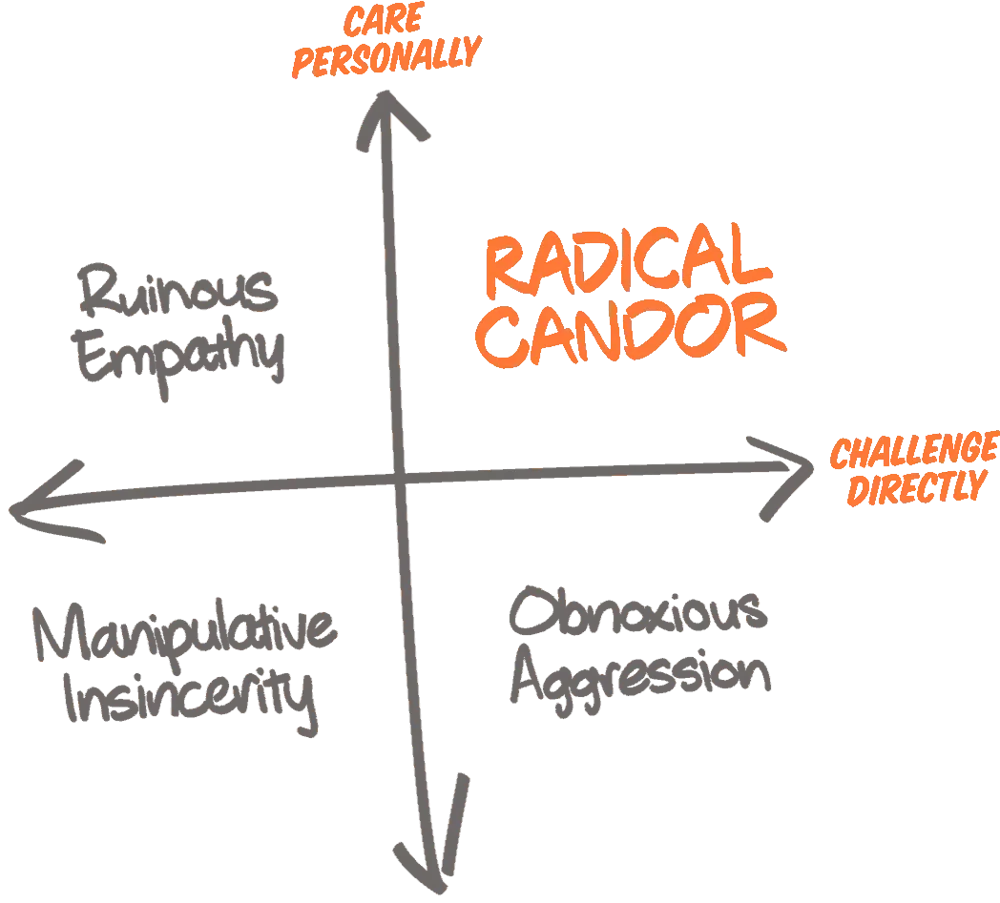
So I read a book about leadership recently. It was written by a white woman who’s worked for huge companies like Google and Apple. The book is called Radical Candor by Kim Scott and I really enjoyed it.
The premise is basically this: for leaders, there is an axis of caring personally and challenging directly. You want high levels of both to run an effective team.
Let’s break the axis down…
I did notice that I kept feeling behind this year. I do think some of that is a function of coming into the late part of my early career and I think some of it is more systemic than will ever be something that I can take responsibility for or action about.
But some of it is also that I am surrounded by people who are further along than I am.
I’ve been no contact with my step mother since I was 15 and sent to live with my uncle. I’ve been no contact with my mother since 2019. Since the day I sent the no contact email, I’ve been torn.
A part of me, the same part that loves a traditional holiday set up, has longed to find a way to “get over it”. I want very little more than to wake up and realize that I was wrong, I was seeing and understanding it all wrong and there is a salvageable relationship with this person who means so much to me. That I could follow through on the self abandonment that served to get me through my childhood and adolescence (just barely) and it would mean that I finally get a hug from my mom.
But alas, even if I found a way to do that, I would bleed out from the wounds she inflicted. She’s a Knife Person, she cannot actually hug me without her sharp edges catching on my self worth and tearing it to shreds. To love her is to betray myself, all my little parts that most need my big self to care for and protect them.
I’ve had to figure out boundaries the hard way. I grew up in a very un-boundaried house. It was unstable, unkind, and unpredictable. The expectations of the adults in my life were a mystery to me (and often to each other and even themselves). My own needs were viewed as “too much”, overwhelming, dramatic. Emotional exploration and processing were not the name of the game.
This became a big problem as I got older and picked friends that mirrored my home life. I was never comfortable directly expressing or acting on my needs until my system just couldn’t take it anymore. I found friends who didn’t care for themselves well and took it out on me.
It took me years of feeling unmoored, questioning myself and my ability to be loved, before I would figure out that the key to the healthy, stable relationships I craved was in fact boundaries.
I recently went on two big trips though I’ve been traveling all my life. I first flew unaccompanied minor at 13 and before that my mother and I made frequent trips to visit family several states away.
Similarly to being a lifelong traveler, I’m also a lifelong fatty and my mother has been fat my whole life as well. We have been fat travelers as long as I can remember. But it’s only been in my recent travels, alone, as an adult that I’ve really felt the brunt of fat traveling.
Live Events

Hosted by: Neuropebble
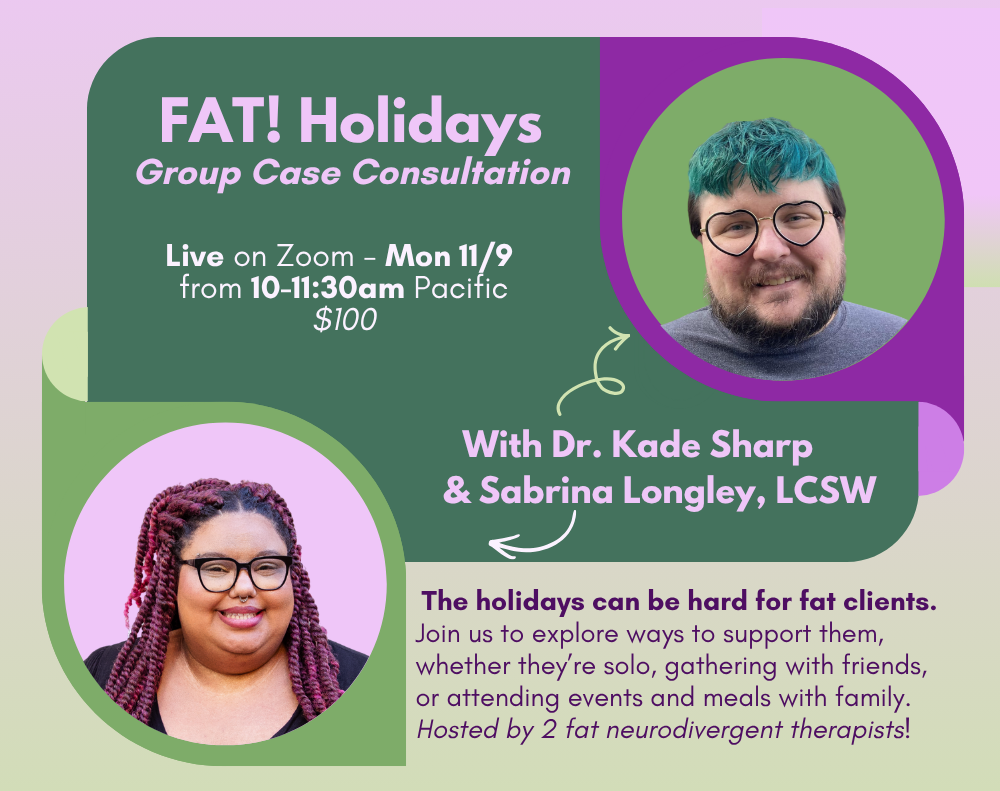
FAT! It's not a bad word - in fact, it can be grounding, empowering, and even exciting. Join us this October for an all-day virtual event where we are centering fat presenters who will get you feeling excited and ready to support your fat clients.
Hosted by Curious Cryptid Learning
Join Sabrina & Kade, fat neurodivergent therapists with over 14 years of combined experience, to discuss your clientele and get support in a welcoming group format. We invite all types of questions about fatness, anti-fat bias, healthism, and relationship dynamics. Questions about clients of any age welcome - not limited to adults.
Hosted by: Curious Cryptid Learning
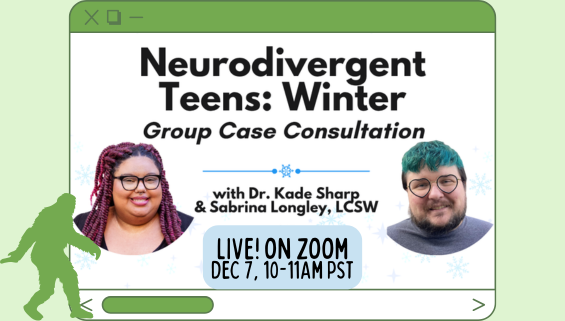
Join Sabrina & Kade, neurodivergent therapists with over 14 years of combined experience, to discuss your clientele and get support in a welcoming group format. We invite all types of questions about teens, family dynamics, fatness, anti-fat bias, sexuality, gender, and relationship dynamics.
Hosted by: Aces Up Your Sleeve Podcast
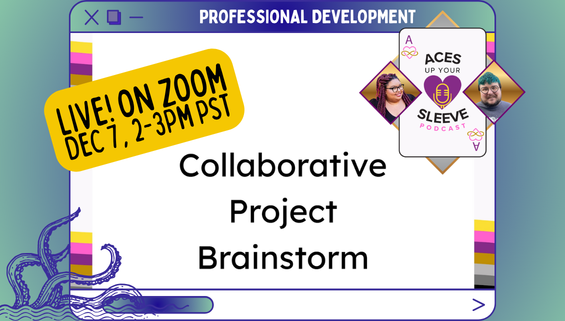
All about building collaborative business projects and relationships for neurodivergent entrepreneurs! Your attendance to this 1 hour webinar will also get you 2 PDFs (more info below.) You'll be squared away to start collaborating on projects for the new year!
In 60 minutes, we'll cover:
Where to meet potential collaborators
How to use our blueprint and inventory PDFs
Answers to your questions
And so much more!
🤝 This is great for folks wanting to branch out from their therapy practice.
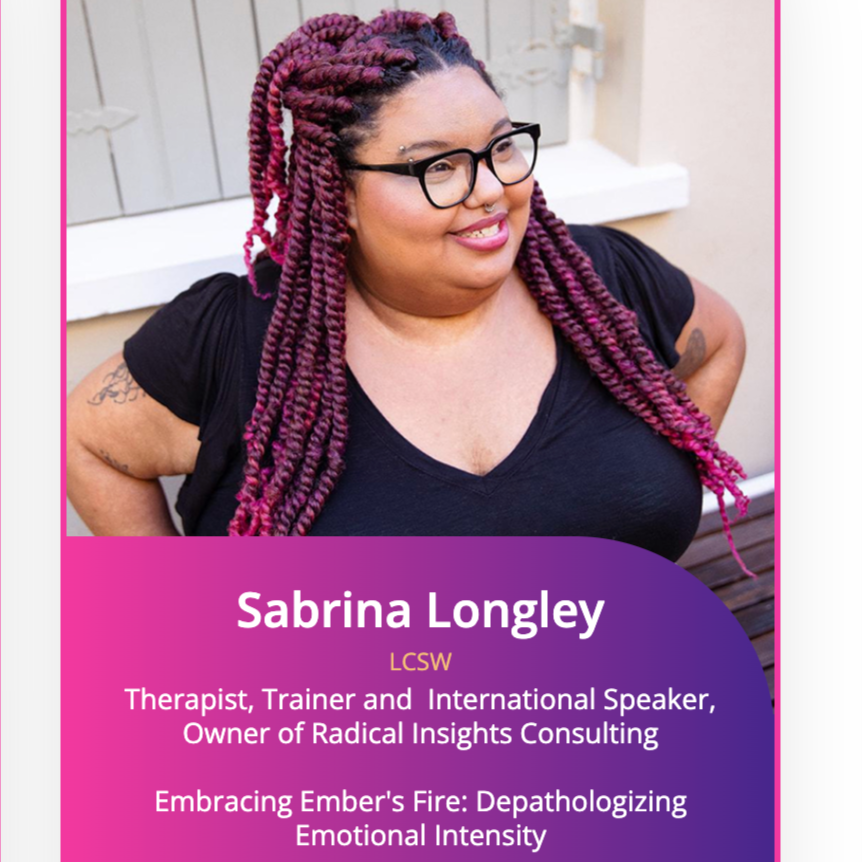
The story of Ember in Elemental is one of being a misfit in many ways. One of the most impactful (and neurodivergent) is her big, fiery emotions. Those with BPD, RSD, and meltdowns know all to well how much of an outsider powerful emotions can make one feel. Join Sabrina Longley, LCSW to learn how these can also be powerful tool to embrace, especially in the clinical space! Bringing lived and clinical experience, Sabrina will guide you through accessing and aiming big emotions to connect deeper!
On Demand
Hosted by Neuropebble
2 NBCCs
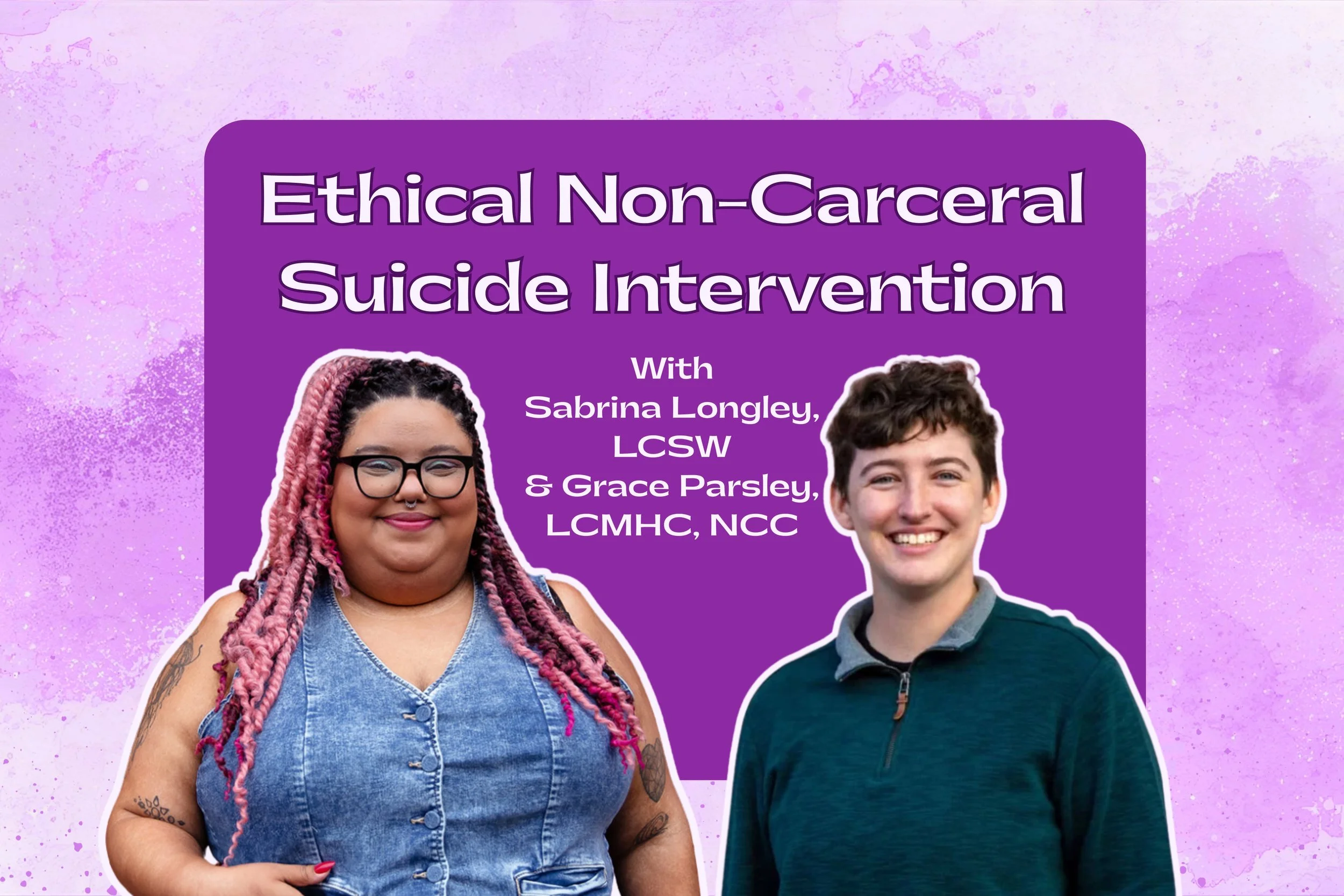
Ethical support for clients experiencing suicidal ideation can feel overwhelming and isolating, especially as a non-carceral therapist. If you’re ready to get un-stuck join Grace Parcley, LCMHC and Sabrina Longley, LCSW in this training all about interventions for suicidal clients that don’t rely on carceral systems.
Hosted by: Diverge x GJV Consulting
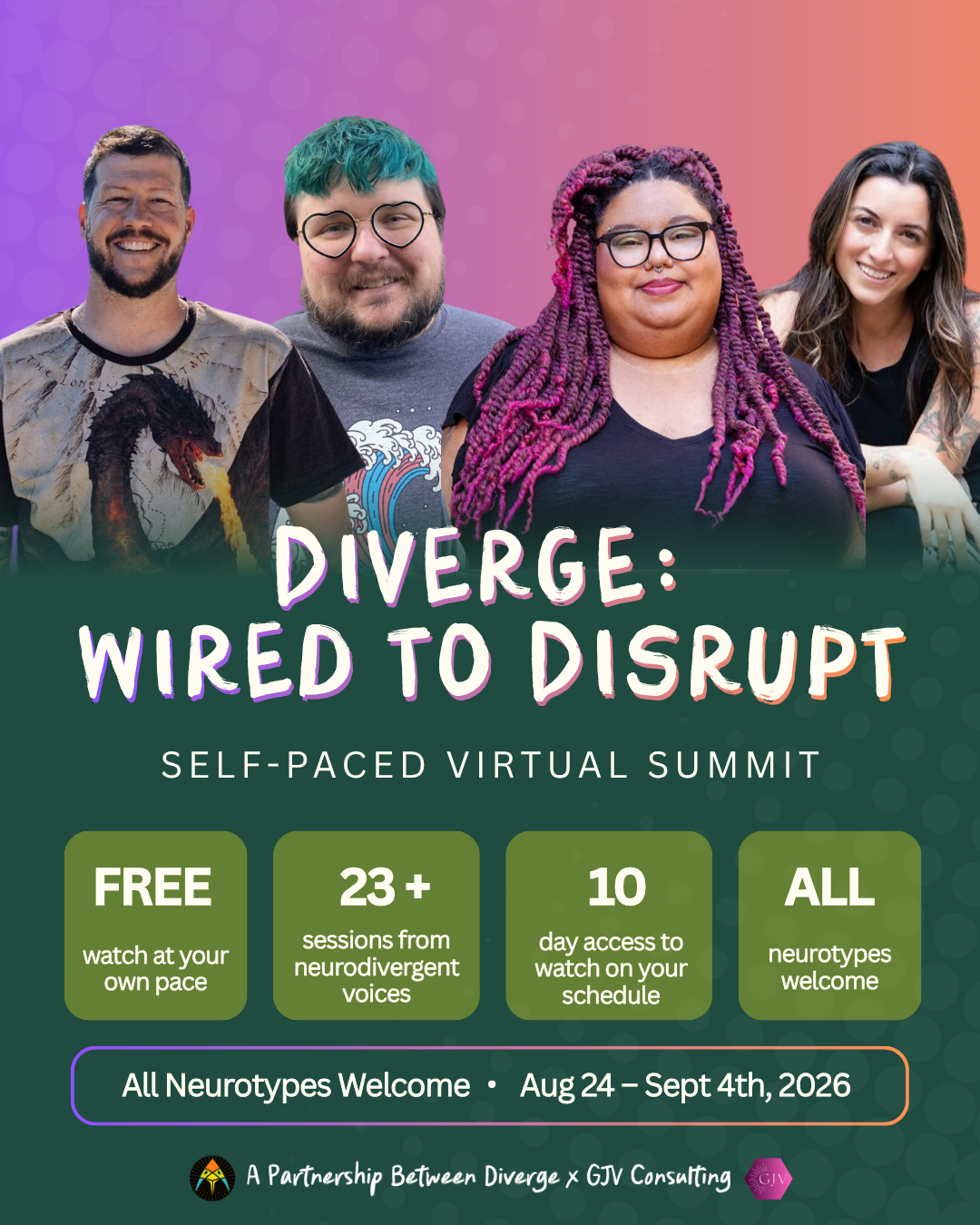
Diverge exists because Neurodivergent entrepreneurs have been building differently for a long time — often without seeing themselves reflected anywhere in "business" spaces. Not in the speakers, not in the pacing, not in what gets called success.
This summit brings together 23+ Neurodivergent business owners, authors, coaches, doctors, physical therapists, mental health therapists, podcasters, and creatives doing the actual work — building on their own terms, in their own ways, anchored in authenticity and lived experience. Multiply marginalized voices are centered throughout, not just buzzwords in the disclaimer section.
My talk will be about neurodivergent business partnership:
Entrepreneurship gets talked about as a solo journey. It isn't. You'll hear from a neurodivergent business partnership navigating two completely different neurotypes and how they make it work across distance.
Hosted by Curious Cryptid Learning
1.5 NBCC CEs, 1.5 AASECT CEs
When was the last time you played? No, seriously!
10 years ago? More? One fundamental piece to inner child healing is play- and we’re going to teach you about a very unique way!
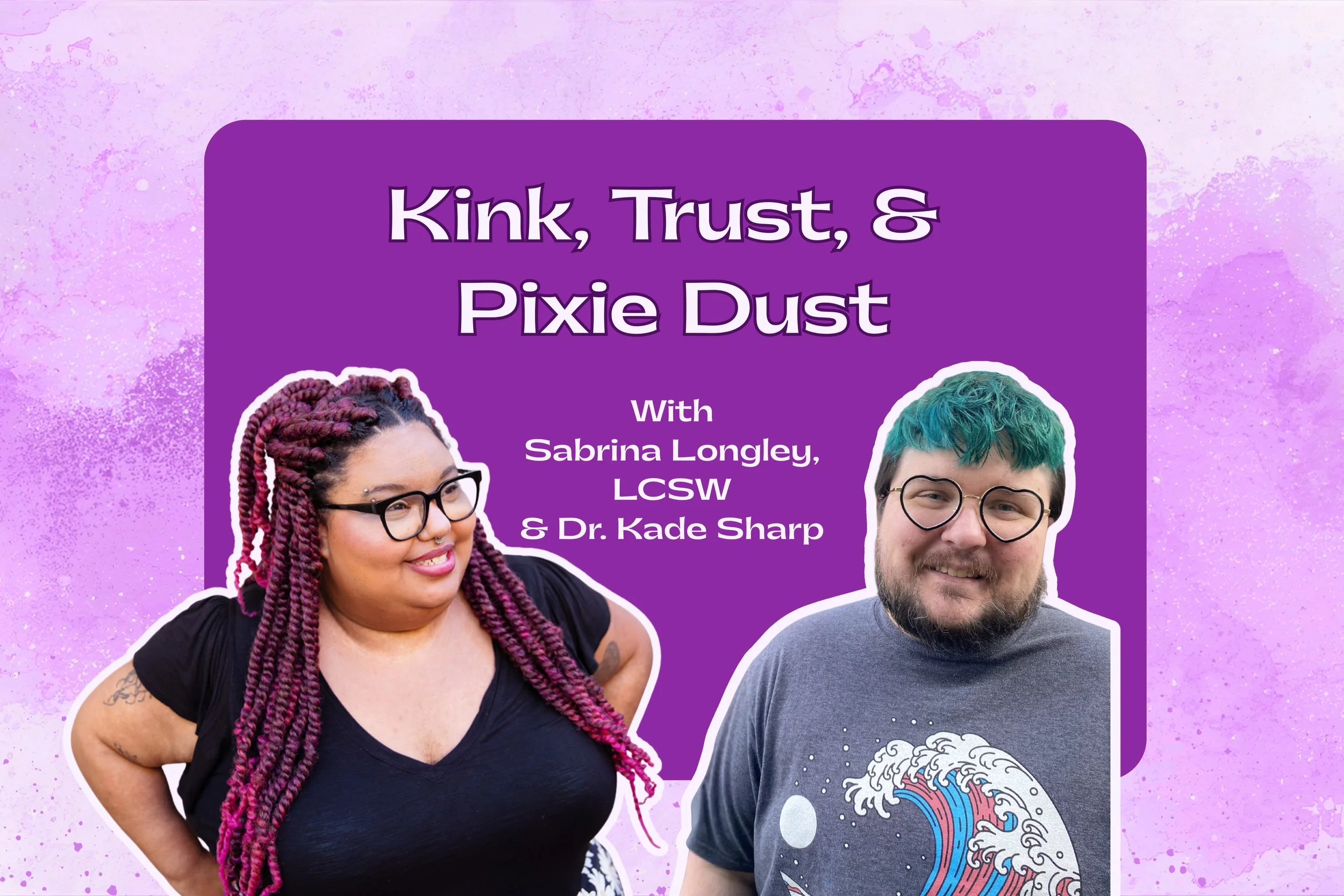
Nearly half of the adults in the US have at least one kinky fantasy. As therapists, we can harness the therapeutic use of playful kink to support our clients in self-attunement, sensory joy, self-advocacy, and healing attachment trauma.
This workshop will cover the current research, ethical best practices, and consent and boundaries skills. You will walk away with actionable kink activities to better serve our clients. So come join Dr. Kade Sharp and Sabrina Longley LCSW, for play time.
Hosted by Neuropebble
1 NBCC
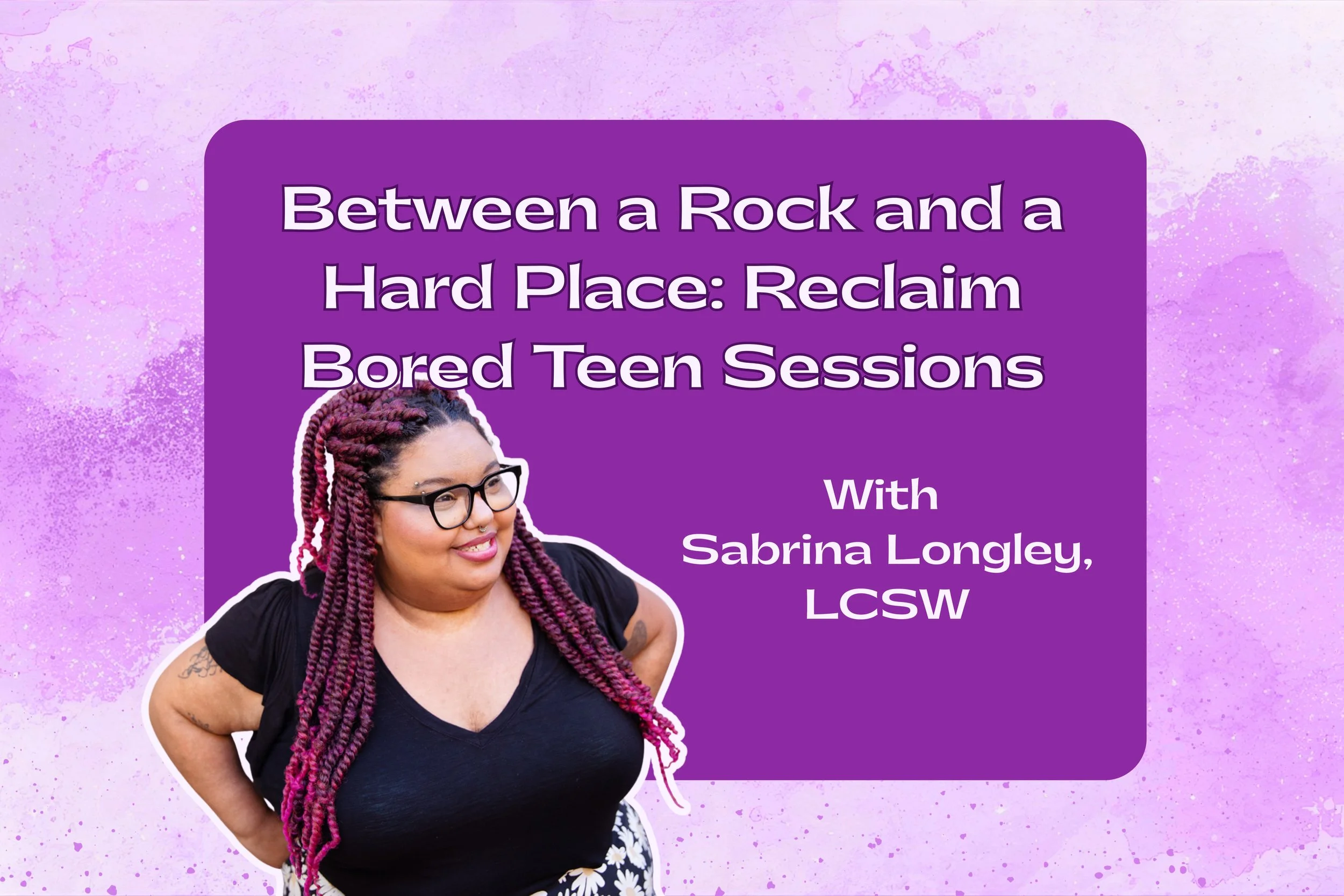
The hour ticks by and your teen client has said naught but 5 words. Far from hyperverbal clients, these teens are bored, scared, or just plain quiet. Sessions like this leave you feeling inadequate, confused, and frustrated. How the hell can you break through to quiet, bored teens? More importantly, how do you get them to break out?!
Join Sabrina Longley, LCSW to explore how to feel empowered when facing quiet teen sessions. Learn actionable techniques and more importantly the reasons behind the silence in the first place.
Hosted by Neuropebble
2 NBCC CEs
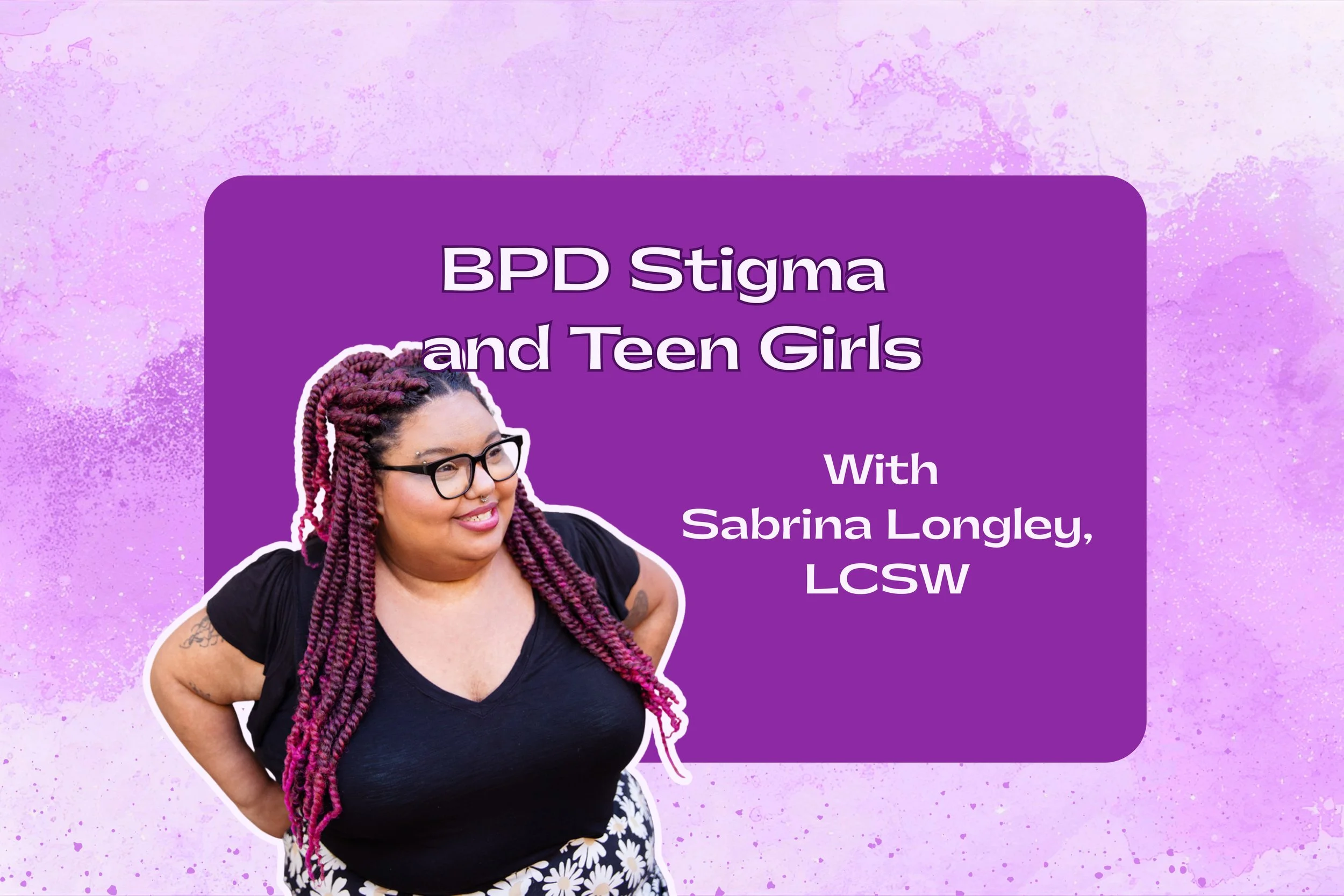
BPD is a stigmatized and highly misunderstood experience and diagnosis. If you’ve ever felt confused, frustrated, or just all around overwhelmed by the diagnosis and experience of Borderline, you’re not alone! Then add the confounding factor of adolescence and you’ve found a big gap in both research and training! Join Sabrina Longley, LCSW, a DBT therapist with lived experience of BPD to get to the bottom of the harms of BPD stigma on teen girls! Build your confidence and learn actionable ways to support the clients you care so deeply about!
Hosted by Neuropebble
2 NBCC CEs
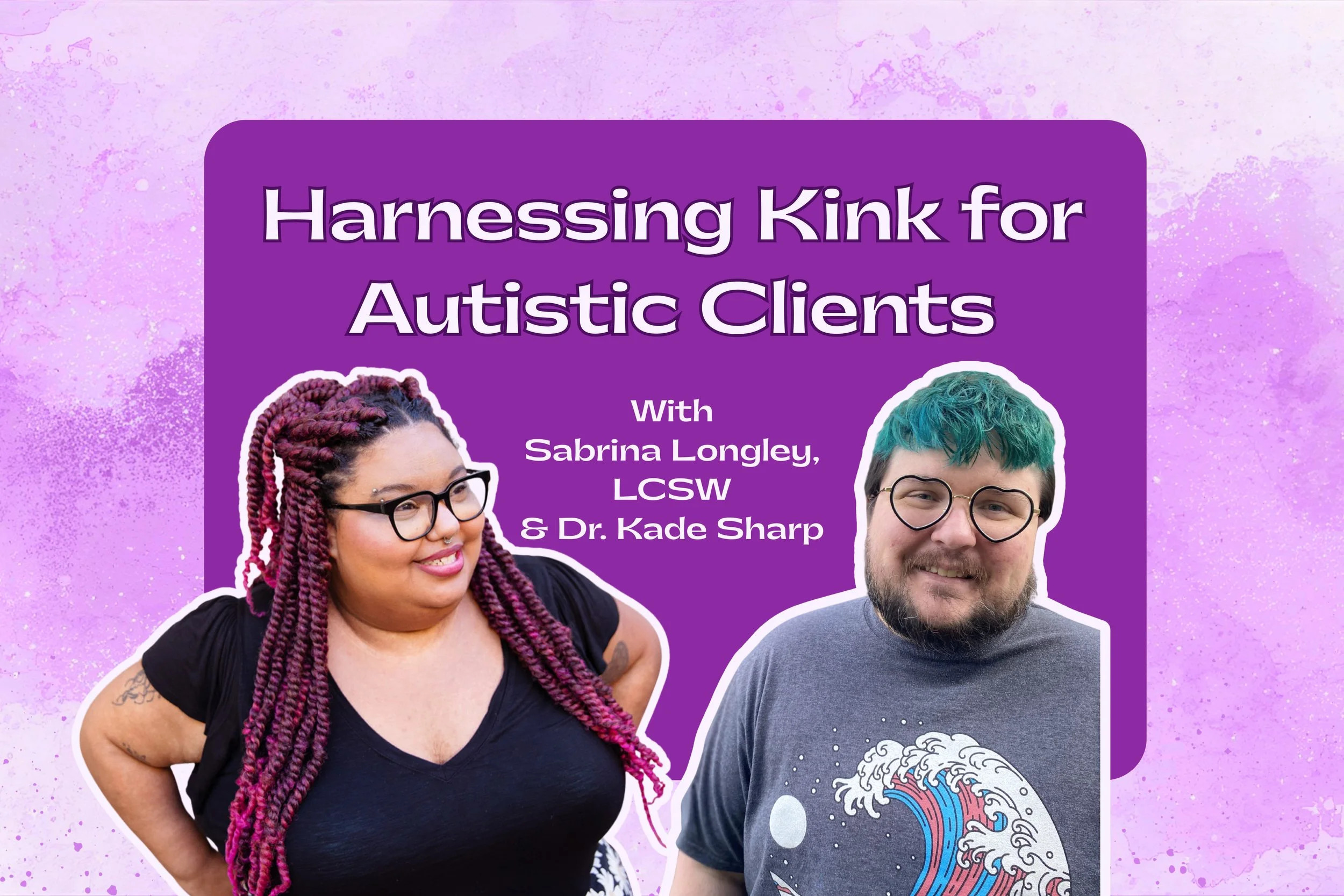
Did you know that autistic folks are more likely to be interested in kink than non-autistic people? Do you feel confident in supporting your autistic clients to explore their kinky side? We can harness the unique structure and ethos of BDSM to help our clients in finding sensory joy and strengthening their communication! Join Sabrina Longley and Dr. Kade Sharp as they explain the ethical considerations and benefits of kink in regards to autistic clients. You will leave with actionable activities for your clients to engage in and resources for further exploration.
-
"Incredible facilitator skilled in presenting valuable info while keeping attendees engaged and not overwhelmed, bored, etc. Highly recommend."
- Training Attendee
-
"This was a very engaging and interactive ethics training that went way beyond the typical ethics training of all the "what not to dos" to help discuss the grey that is often present in our ethical dilemmas."
—Training Attendee
-
"After seeing Sabrina speak at an international retreat in Greece, it opened my eyes to how engaging and interactive a speaker could be! It was obvious that it was done with so much intention and passion in her presentation as well as how she answered follow up questions. I look forward to the next time I get to see Sabrina speak!"
—Presentation Attendee
-
"Sabrina in a gem. More of her trainings please!"
—Training Attendee
-
"Sabrina is an absolutely badass clinical social worker, highly skilled in leading nuanced conversations about ethics. Highly recommend!"
—Training Attendee
-
"One of the best ethics trainings I've been to. Kept me engaged and got me thinking. I'm definitely going to go check out more of Sabrina's content because she's my kind of people."
—Training Attendee
On this week’s episode, we’re joined by the amazing Bobbi-Jo Molokken! As most ADHD and Autistic parents of ADHD and Autistic kids know things can get out of hand quickly. You feel all the pressure to parent well and meet your kids needs while preparing them for the “real world” and yet it feels like sand through your fingers trying to keep it all going. What most parents don’t know is how the F do I even help my ADHD or Autistic kid with executive functioning. Bobbi-Jo is here to help, as an ADHD mom of two ADHD kids AND a licensed therapist and ADHD coach, Bobbi-Jo can help from all angles! Answering questions about reasonable expectations, how to support effectively, and on the bonus episode her own experience with executive functioning, you don’t want to miss this one!