

What Community Can Look Like When No-One’s the Bad Guy
I’ve been the bad guy. And I’ve made others into one too. It’s a tempting and societally pressured response to many feelings of discomfort.
The Problem with Bad Guys
As much as life might be easier, more comfortable, if there was a villian it leads us nowhere. We get to point the finger. “If they would just change everything would be better”. It halts real progress.
It absolves us of looking inward, of finding our part of the pattern. That work is hard and messy and honestly can be overwhelming.
What’s more, it keeps us from actually attending to challenging relationships. It’s an “out” that lets us remain safe in conflict avoidance (even when making someone the bad guy can be very confrontational!)
Sabrina, what about Knife People?
Even knife people aren’t “the bad guy”. I know, I know, they hurt real bad! And yet, they are often hurting themselves. It’s not an excuse to hurt us, but it doesn’t make them unilaterally bad. Again, we give up relational skills when we write them off as just “bad guys”.
What this doesn’t mean is that we keep Knife People in our lives forever and ever with no mind for our own wellbeing. Boundaries don’t go out the window!
What we gain instead is the ability to hold both things at once, they hurt us AND they are hurting.
We Can Community Better Than This.
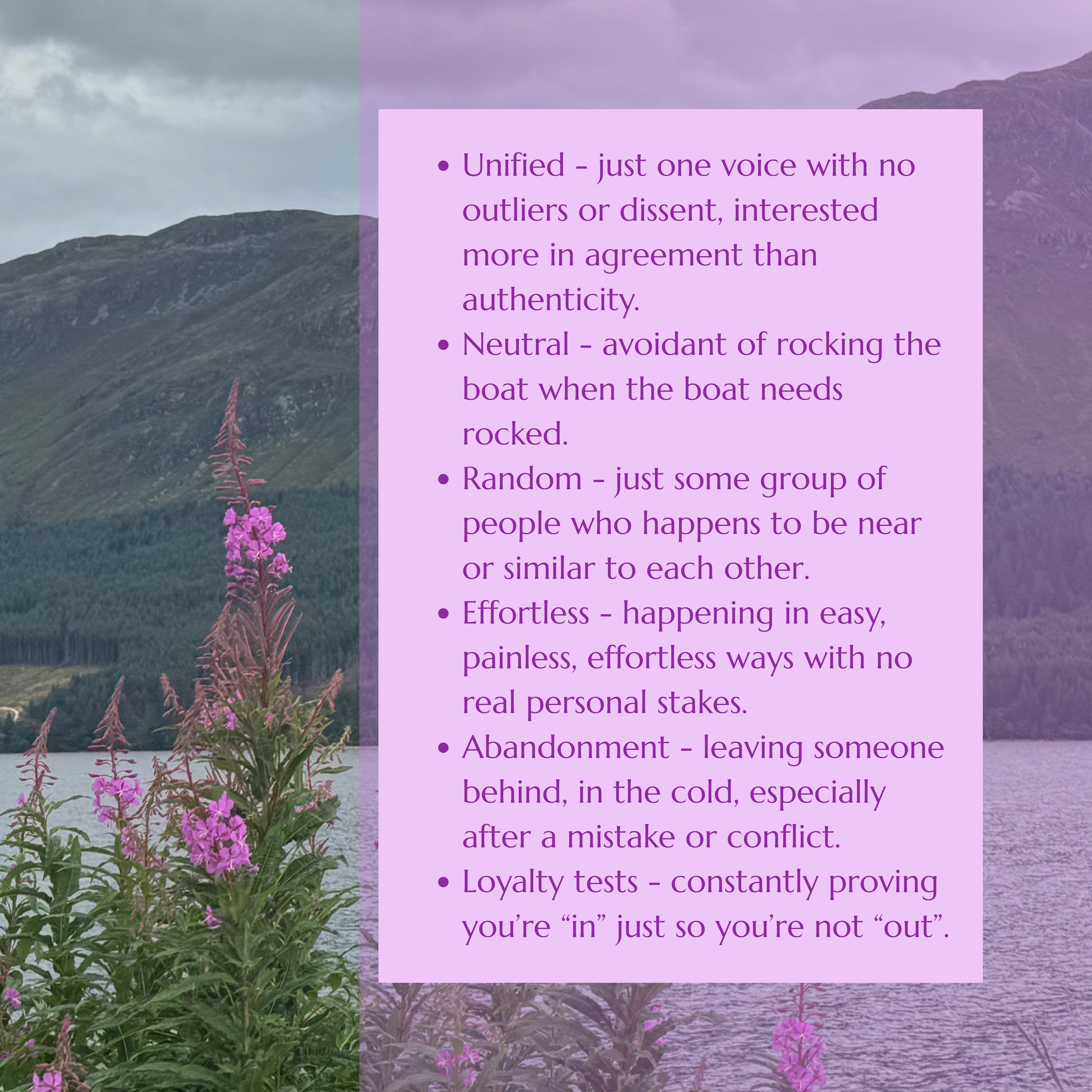
What Community Is Not (for me)
When community starts to be UNREAL it requires people to start looking for and pointing out Bad Guys to avoid being saddled with the lable themselves. Things begin to be shaped by fear, not relationship.
Community could be something else entirely
What if there was no fear of being found out to be “the bad guy”? No perfectionistic standard to cling to? What if you could mess up and still be loveable?
Well, then I guess you’d mess up.
You’d hurt people sometimes. You’d even do harm.
Wanna hear the hard part? You already do!
And in our current society where people are disposable, that truth has to be buried. Your best kept secret, lest you be labeled the bad guy and forced out.
You couldn’t possibly take accountability, real accountability, while that’s true.
But in a society where messing up was expected?
You could face the fuck up. You could respond without fighting, flighting, freezing, fawning, or flopping. You would be safe.
And so would others.
You could let your guard down, the one that tells you to correct every word to show that you’re right and they’re wrong. You could offer correction from care. And it would be received as such!
But How?

Start with yourself.
The nice part is that you can make this real in your life today.
What expectations do you hold yourself to, do you punish yourself for stepping out of line on? Where, when, and how do you exile yourself for mistakes? Where do you see yourself as the bad guy?
It’s ok for these questions to make you think things like
I don’t do that to myself
My expectations are reasonable, without them I’d be a bad person
If I hurt someone I should be exiled
No, no, no, no, no
I hate this
That’s ok, the nice part about a blog is there is no urgency. Take your time. Attend to the parts of you coming up in defense and fear.
Once you can answer these questions clearly and manage the internal response you get, you can move forward. Next is making the shift.
Actually forgive yourself. Validate the things you do/think/feel. Remember that validation isn’t agreement, you can still be committed to change even if you understand where your actions/thoughts/feelings came from.
Build an internal trust with yourself that you are trying, even and especially when you mess up.
Figure out how to repair, with yourself and others, instead of continuing to exile. This might mean repairing with parts you previously exiled (and this might be done with the help of a trained therapist if needed).
Realign to values, you can’t change the past but you can orient your future.
Remember urgency is a tool of white supremacist culture. It’s a lie told by capitalism.
Then offer it to others.
In Loving Kindness practices (which I first learned in DBT but actually originates from Buddhist tradition) we begin with offering loving kindness to ourselves, then people it is easy to offer it to (friends, loved ones), then neutral, then people you don’t like, then people you hate, then the whole world.
You can use the same strategy here. Start small, with people you already like and want to be in relationship with (tbh, start with your clients for whom you already hold unconditional positive regard).
Then move outward. It’s slow. It’s Possible.
It’s worth it.