

At the Center of Racial Communication Challenges
How whiteness ruins everything, again.
So I read a book about leadership recently. It was written by a white woman who’s worked for huge companies like Google and Apple. The book is called Radical Candor by Kim Scott and I really enjoyed it.
The premise is basically this: for leaders, there is an axis of caring personally and challenging directly. You want high levels of both to run an effective team.
Let’s break the axis down…
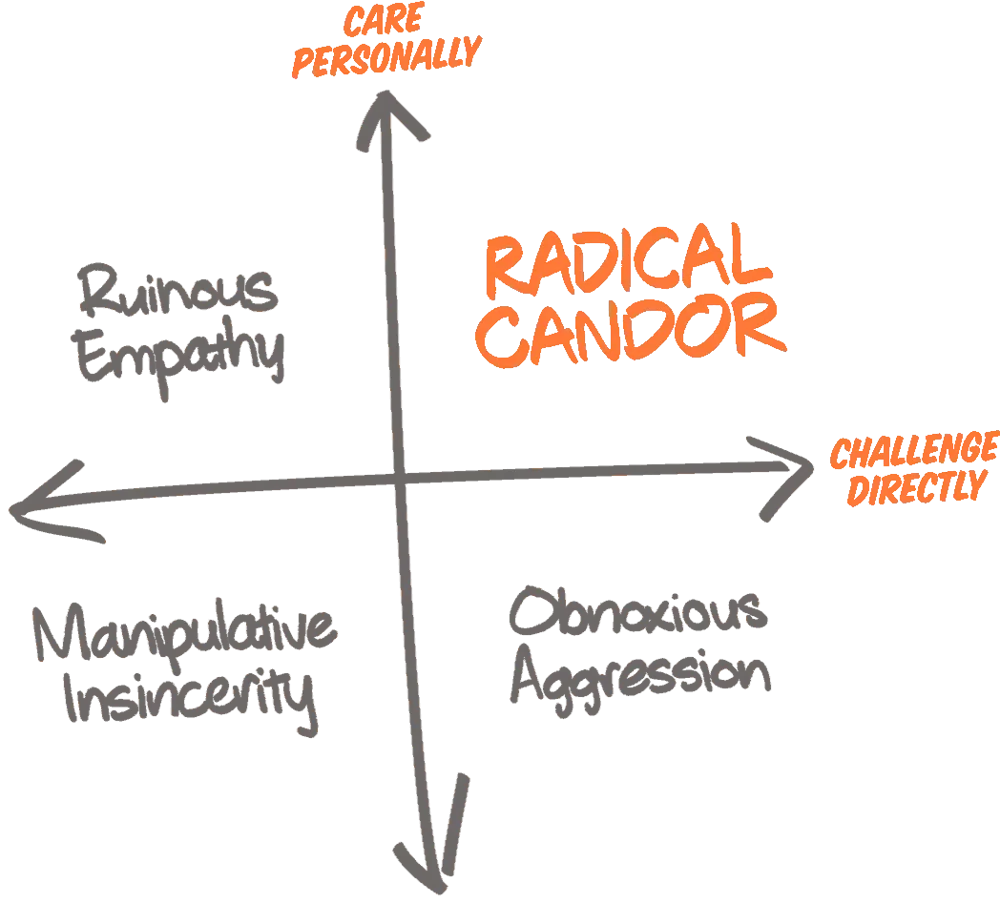
With high levels of caring personally but low levels of challenging directly you might be ruinously empathetic. This term immediately made me think of whiteness, how it allows for relationships go up in flames because it refuse to engage directly about needs, wants, and disagreements. Usually this is blamed on some kind of phantom “rudeness” in direct challenging.
If you have both low personal care and low direct challenging, according to the book, you have manipulative insincerity. The urge to leave it at “need I say more” as it relates to manipulative insincerity and whiteness is strong but this is a blog so I’ll add some thoughts. I would be shocked, stunned, screaming, crying, and throwing ass (credit to @wreckno) if any Black, Brown, or Asian person hadn’t met a white person who was manipulatively insincere. This is often the default, especially online, of how white people engage with anything even remotely confrontational. Now, in fairness, online it is hard to engage with people in a way that cares personally. You don’t usually know the other person personally in a big Facebook group comment section or in a thread on Threads. And as we’ve already discussed, white people hate challenging directly.
By this point, if you’re reading this and white you’re probably feeling pretty called out. Hopefully if you found yourself in my little corner of the internet this is not surprising to you.
Ok, so on with the axis. Scott aligns the idea of radical candor as happening when you care personally a lot and also are willing to challenge directly in a strong way. This, she asserts, is the key to badass leadership “without losing your humanity”. More on that later.
The final corner is a low level of personal care with a high level of direct challenging, it’s obnoxious aggression. It might shock some to hear that in the book Scott says if you can’t be radically candor…ous, being obnoxiously aggressive is the way to go. Of course she’s talking about leadership, where staying silent about problems can break a system of people and make business (and profits of course) grind to an ineffective halt.
I argue that this is still true in other situations and tends to be how I prefer to be engaged with if someone can’t access radical candor for some reason. Tell me I have lettuce in my teeth or that my fly is down, like an asshole if you need to, instead of letting me walk around and find it myself later. Tell me when you think I’m wrong and why your way is better so we can end up doing the best possible thing with all view points accounted for. With care if you can, without if you must, but at any cost, tell me.
This doesn’t seem to be how whiteness feels, as a system. It would choose ruinous empathy or even manipulative insincerity any day. What interests me most though, is two fold:
whiteness would even chose manipulative insincerity over radical candor. Anything to avoid directness. Directness to whiteness would be it’s downfall so it is it’s biggest enemy.
whiteness sees all forms of direct challenging as obnoxious aggression, especially from BBA folks. Because whiteness is so threatened by directness it views any form of it as aggression, inaccurately. The worst thing you can be, to whiteness, is aggressive. It’s not a surprise then that cultures that communicate more directly (such as Black folks) are overwhelmingly seen as aggressive (of course not the only reason).
So, what can we do with this knowledge? How do we move from this place of understanding into praxis?
For Black, Brown, and Asian folks, this is the time to not back down. To remain direct and recognize and name the attempts of whiteness and white people to categorize you as aggressive and thus ignorable. When safe for you to do so, name this white violence directly and stand your ground. If that’s not safe, consider calling in a white friend or other “safe” white person to name it.
White people, name this shit. Loud! Don’t step on BBA folks to do it but be ready to be called in. When whiteness wakes up inside of you and tells you not to be rude, to offer the same information the BBA person just offered but in gentler (less direct) words, DONT. Don’t offer information BBA folks have specifically decided not to offer in the name of being “helpful”. Notice the urge to tone police and knock that shit off. Intentionally listen to people you find abrasive to normalize and regulate to directness. Start directly challenging other white people in all contexts, notice what happens when you do it vs when BBA folks do (people might still respond to you as if you’re being obnoxiously aggressive, notice how that feels and remember that this is how BBA folks are treated all the time).
Walk that Walk.
This is especially important as “aggression” is one of the top excuses to incarcerate and harm a BBA person. Even more than that, the “fear” that some people label as “white fragility” (white fragility isn’t real, there’s too much power in whiteness for it to be fragile) is dangerous. whiteness get’s to be afraid and that fear is not only validated but acted upon. Recognizing that the fear is not of the BBA person who is being direct, it is of directness itself.
Back to radical candor.
Here’s the real test, to my mind. Unfortunately whiteness has touched us all and made it more difficult to engage directly with each other, especially while maintaining personal care.
This actually brings me back to something I’ve reflected on a lot over the past decade: what do we owe to and expect from each other. How on earth do we reconcile this expectation that we are more in community with 8,000 people in a Facebook group than we are with the person living in the home next to us.
Don’t get me wrong, I have met some of the best people in my life online. My partner and I met in a Facebook group, some of my best friends (and the people who supported me in creating this business) I met online, I found my dream job on social media. I invest into those spaces and feel comfortable claiming I know and am known by some there.
But I think in the context of radical candor we have to really investigate what caring personally means and what the limitations are.
We can only care personally for the people we know personally. We can care more broadly for people we don’t know personally, we can care about people we don’t even know and couldn’t really fully imagine, but not in a personal way.
In the book, Scott examines how a good boss or leader must get to know their employee personally to ensure there is capacity to care personally. Trying to act as if you care personally when you don’t actually know someone personally rings false every time. When there is also a matching lack of direct challenging we have strayed into manipulative insincerity.
Within racial dynamics this plays out in predictable but brutal ways.
We already know that BBA folks have to know much more about whiteness than white people need to know about BBA folks. Culturally sure but this shows up interpersonally too. It’s a matter of survival that BBA folks see the patterns of whiteness and keep up with the trends. white people on the other hand are actively disincentivized to know about Black, Brown, and Asian folks.
whitness expects understanding without question or effort. I often see whiteness expect to be handled with personal care without the effort to be in relationship. It of course has no intent to offer personal care back.
This sensitivity and expectation to be handled with more personal care than has been earned or built, I think, leads to increased feelings that BBA folks are engaging in obnoxious aggression. Again, whiteness hates any amount of directness. Mixed with the unearned expectation of personal care, you have a recipe for interpersonal harm.
We have to re-evaluate what we expect from each other, what we mean when we say buzz words like “community” and “relationships”. How are we creating enough safety that others can come to us directly with their concerns and needs. When there isn’t enough personal care do we default to manipulative insincerity or to obnoxious aggression? Do we work to build that care so we can get to radical candor? I think it’s worth deciding what we want from ourselves and reflecting on what we need to do to get there.