

Maybe She’s Born With It, Maybe It’s Borderline
I wanted to share my diagnosis story, my borderline diagnosis story.
I do want to share a few content warnings for this one: I will be discussing emotional ab*se, emotional n*gl*ct, self h*rm, and su*c*dal ideation and actions (not in any great detail). Please care for yourself however you need, take breaks or skip this one entirely if you need to!
I guess in some ways, due to the nature of BPD and the attachment traumas we so often see at the base of them, my diagnosis is a little bit of my life story. Don’t worry reader, I won’t take you through every grueling detail (I don’t even remember them all lol), but I promise it will pay off. I’ll give you a little teaser.
My therapist diagnosed me with BPD in the most affirming way I can think of!
Ok, let’s get started.
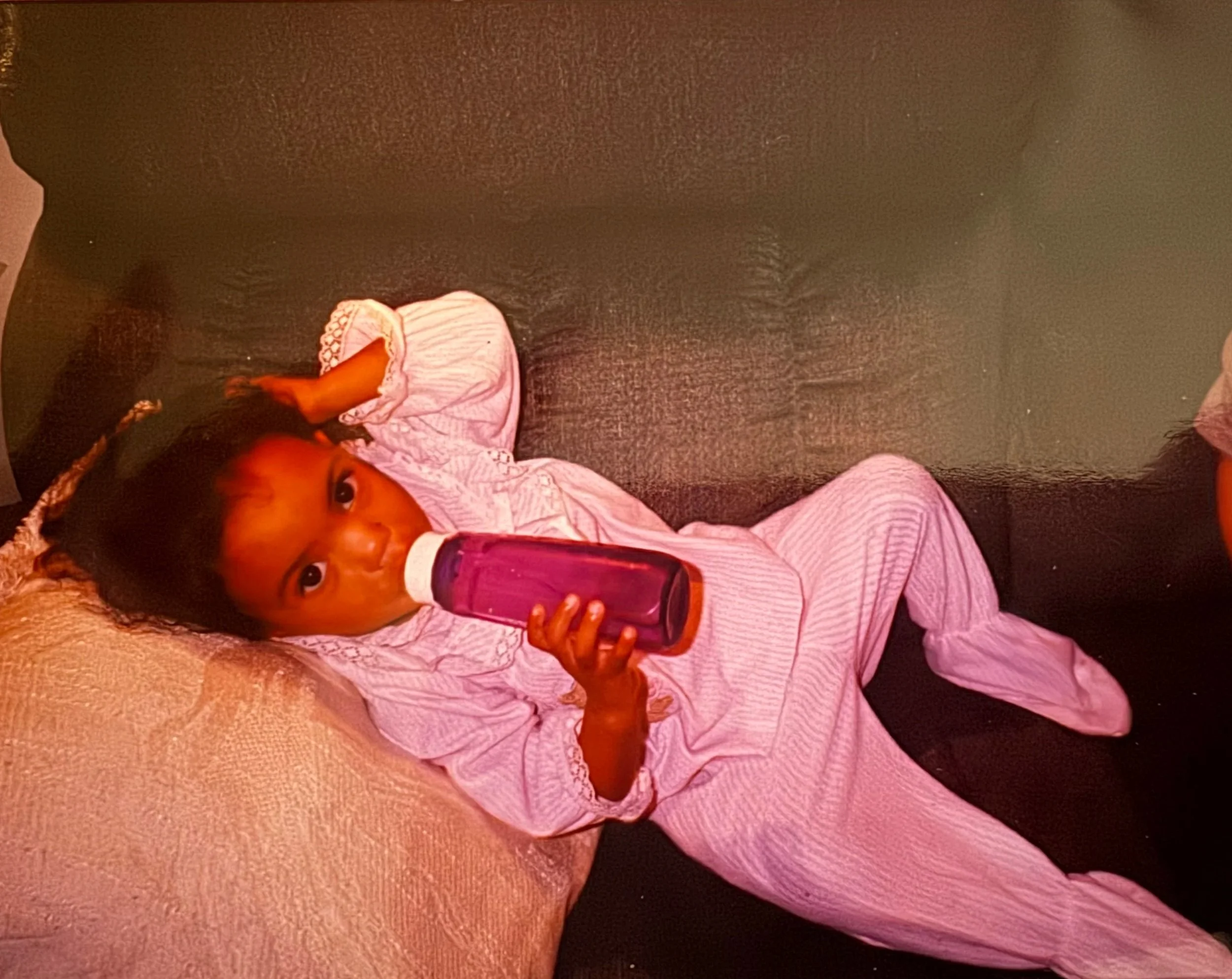
My life started with a pretty big abandonment. I was only 2 months old when I was left by myself in a shelter. The prevailing theory was that my bio mom left to “party” (which my very literal autistic child brain thought she actually went to a party, but no, a euphemism for drug use alas). I was taken by social services and offered to the woman who would adopt me. I was malnourished and screaming, wearing clothes too big for my tiny frame.
Fast forward and my mother who adopted me raises me knowing I was adopted - I literally don’t remember learning this and we had adoption poetry all around our house. The woman she had been with when I was adopted had left us and every airplane that flew over head I waved to, saying bye to my “mama-nita”. Clearly, I already felt loss profoundly from an early age.
At some point early on I started seeing a therapist because by the end of second grade I had been seeing her for a while. I was working mostly on “anger related to adoption trauma”. I also started showing signs of sensory overwhelm and ADHD strongly enough that by 3rd grade I had an IEP. That’s a different story for a different time.
So I was raised primarily with the belief that I was chosen, that my personality was affected much more by nurture than nature. My mother married a woman who was awful and as we know from a previous blog my mother turned out to be a Knife People. Once my younger siblings were born it was almost like I didn’t exist, or rather like I couldn’t do anything right. My step mother got meaner, my mother showed love and care to the twins she couldn’t muster for me (which I am at least they were loved and cared for). All that “being chosen” rolled right down the drain.
All this time I was in therapy, and damn good therapy too with a therapist who would later come to specialize in Autism in MaGe’s. So much of our work was just managing to get me through the day, the week, the month, and even the year (*clap clap clap* - god I hate Friends).
Figuring out how to build relationships when your only models are abusive assholes is actually really hard. Doing that in middle and high school is even harder.
Soon enough I was hospitalized after a few years of self harm and some SI. After my second hospitalization I was not allowed to go home (a choice made by my mother) and was sent to live with my uncle in Wisconsin (rather than be put back in foster care).
Fast forward again and I’ve moved home to NC and am attending college. For my freshman year I lived in the dorms but come sophomore year I had moved back in with my mother and step mother. Yes dear audience this was an awful idea, I know that now in hindsight. Now, I was getting a bachelors degree in psychology at the time but hadn’t heard of DBT or very much about BPD in the first place. Inevitably a fight got big, and the SI returned, this time with action. When I was hospitalized this time I was required to agree to go to Dialectical Behavior Therapy before being released.
At the time my mother and I shared an amazon account and she bought the books “Stop Walking on Eggshells: Taking Your Life Back When Someone You Care About Has Borderline Personality Disorder” and “Loving Someone with Borderline Personality Disorder”. That was honestly one of the first times I had even heard of BPD, and what a shitty way to first learn that term. The DBT group I had agreed to go to was one for teens and parents (I was 19 at the time and turned 20 while in the group), my mother did it “with me”. I say that in quotes cause she really didn’t take it seriously and as is true with most teen DBT programs only I was required to be in individual therapy. This was the first time someone actually asserted that I was borderline. The therapist running the DBT group had me see her for individual during this time but I managed to continue to also see my regular therapist every other week.
I was really struggling to understand BPD as anything other than the way my mother was blaming me for the extreme pain I felt in our relationship, for the deep gashes in our family (or her family and me as she would say). I got really caught up on the dissociation, viewing it as a full dissociative fugue and nothing else. I felt I certainly didn’t have that experience and borderline was a dissociative disorder (do you see how much I just didn’t know!!) so I just couldn’t be BPD.
Then everything changed when my therapist was affirming.
I came in to session with my regular therapist who by this point I had been seeing for 7 years. I shared about how I felt my mother was trying to make all of our troubles my fault, how I couldn’t possibly be borderline like she kept trying to say I was. To me, that was just another excuse to blame me and skirt all responsibility for her actions and contributions to the turmoil in our lives.
My therapist, who had met my mother and even had her join us in sessions some when I was in middle and high school, asked if I’d like to read the DSM criteria for borderline. To this point I hadn’t really even thought of that, I owned a DSM due to my undergraduate studies in psychology but I struggled to integrate the two experiences.
So, we did just that, we pulled her copy off the shelf and her desk reference so we could each see.
A pervasive pattern of instability of interpersonal relationships, self-image, and affects, and marked impulsivity beginning by early adulthood and present in a variety of contexts, as indicated by 5 or more of the following:
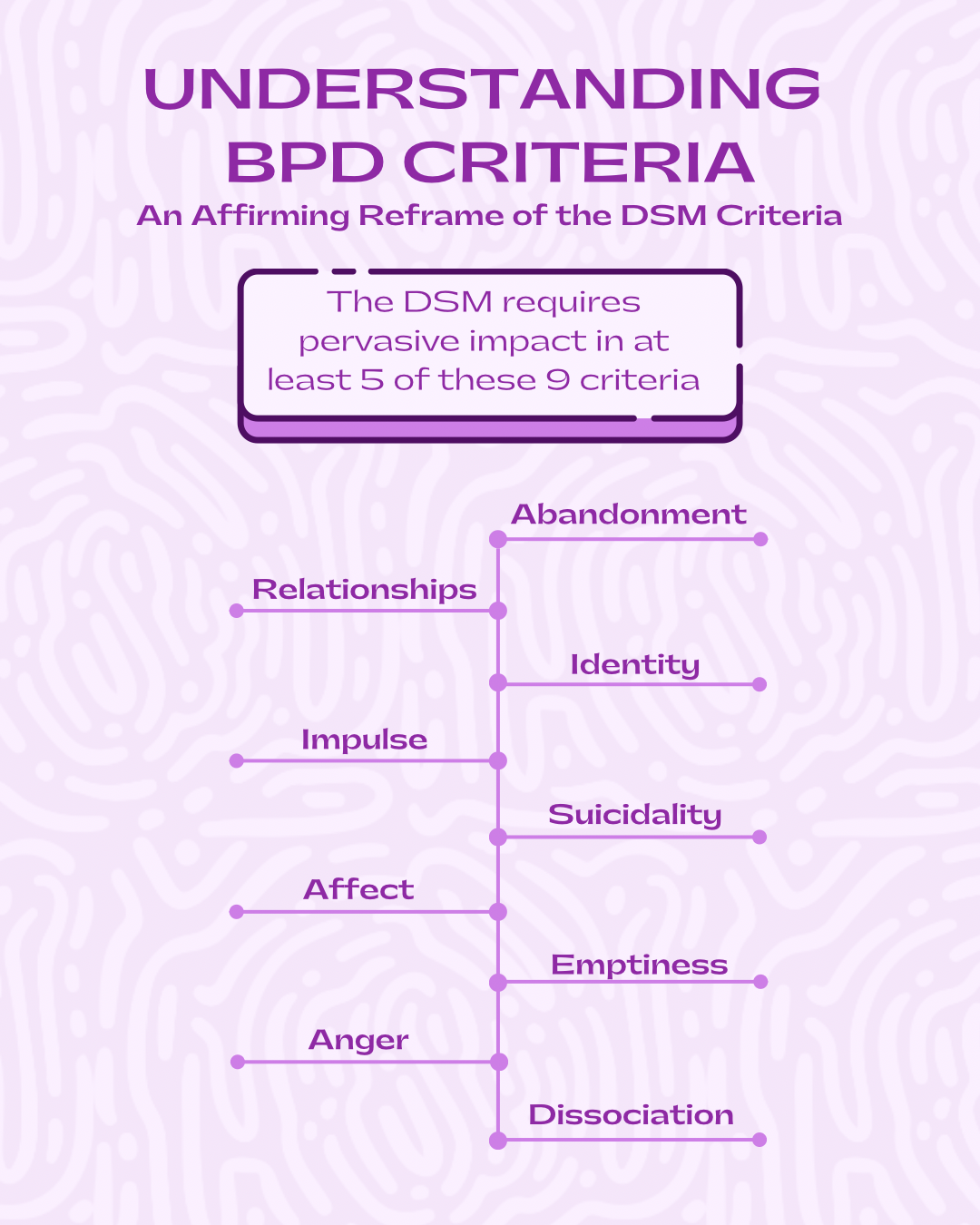
Check out my instagram post here for an affirming reframe of the criteria by Rosie Cappuccino. ———>
Frantic efforts to avoid real or imagined abandonment.
A pattern of unstable and intense interpersonal relationships characterized by alternating between extremes of idealization and devaluation.
Identity disturbance: markedly and persistently unstable self-image or sense of self.
Impulsivity in at least 2 areas that are potentially self-damaging, for example, spending, substance abuse, reckless driving, sex, or binge eating.
Recurrent suicidal behavior, gestures, or threats, or self-mutilating behavior.
Affective instability due to a marked reactivity of mood, for example, intense episodic dysphoria, anxiety, or irritability, usually lasting a few hours and rarely more than a few days.
Chronic feelings of emptiness.
Inappropriate, intense anger or difficulty controlling anger, for example, frequent displays of temper, constant anger, or recurrent physical fights.
Transient, stress-related paranoid ideation or severe dissociative symptoms.
We read each one and she asked me to say whether I thought it applied to my life or not and allowed me complete decision making and control in if I identified fully, partially, or not at all with something.
My responses were as follows:
Kind of but I’ve actually been abandoned so IDK if it counts… (.5)
I guess (1)
Yes (1)
Yes (1) - current me note: I was doing even more of this than I could acknowledge at the time)
Hell Yes (1)
I guess (1) - current me note: I had a lot of shame about my intense emotions due to invalidation I experienced
Hell yes (1)
My anger isn’t inappropriate!! (.5)
I don’t think I dissociate (0) - current me note: I’m still so dissociated I can’t feel my body unless I’m weight lifting…
You’ll notice she allowed me to claim I wasn’t experiencing thing I can now see than I certainly was (and still do) without trying to dictate my experience.
She followed up as any good therapist would, asking particularly about the abandonment. I had basically said that because my abandonment was a real thing I experienced it didn’t count. What she said next blew my mind.
“What do you think your personality is if not a mixture of what you have experienced?”
I mean she had me there. What is my experience of myself, my emotions, my personality if not an amalgamation of the people, experiences, and emotions I’ve known.
I know there’s a specific definition in psychology for personality and she never asserted nor do I believe that personalities can be “disordered”, and with all of that said for the purposes of my diagnosis at the time and to this day this was the most comforting thing she could say.
Why was it comforting? It held the context of my real life and not some idea that I was “broken” which I had heard so long. I felt seen.
So even as much as BPD is hugely stigmatized, even though no personalities are “disordered”, I am very grateful for my diagnosis.
I rally hope we, as therapists, can find a way to destigmatize and learn to support BPDers instead of fearing the diagnosis. I hope for a new name, much more understanding, and much easier access to truly affirming support.
My therapist wasn’t some paragon of perfect BPD knowledge (she was taking a DBT training at the time and I don’t even know if she had ever had a BPD client before me). What she was was compassionate, ethical, and most of all validating. She listened to me, let me guide and created a space like she always did where I could bring my full self.
I know you can do the same for your clients.