

White Fragility Is a Contradiction in Terms
The book White Fragility blew up a few years back and got everyone investigating “Why It’s So Hard for White People to Talk About Racism”
But here’s the kick, it was by a white person.
It didn’t take long for people to start to critique the book, the premise, the author. I’ll be honest I didn’t read it…I don’t read books on racism by white people ¯\_(ツ)_/¯
But here’s what I want to talk about today, while the book was popular among who you would think it would be….the phrase seems to have become popular with everyone.
White fragility.
We all know I like words and their definitions. So the definition from the book is “any defensive instincts or reactions that a white person experiences when questioned about race or made to consider their own race”.
Isn’t that interesting, it claims to be active (reactions) and it’s focused on the white persons experience of their whiteness and their authority on race.
The claim is that white fragility occurs because white people have not built a tolerance for racial discomfort.
This aligns with the characteristic of white supremacy that is the Right to Comfort.
Sounds reasonable enough, white people can’t be confronted about race without becoming fragile as a defense mechanism.
So we need to understand what fragility is.
Merriam Webster to the rescue!
“The quality or state of being easily broken or destroyed".
Hmmm, that’s interesting huh.
So white people become easily broken or destroyed when faces with racial discomfort? That doesn’t seem quite right…
What’s being left out?
The first time I heard the term something felt really off to me. Somehow this term was not…enough.
I finally found the right question after months of considering it, after the white girls started saying “not fragile like a flower, fragile like a bomb”.
Fragile like a bomb.
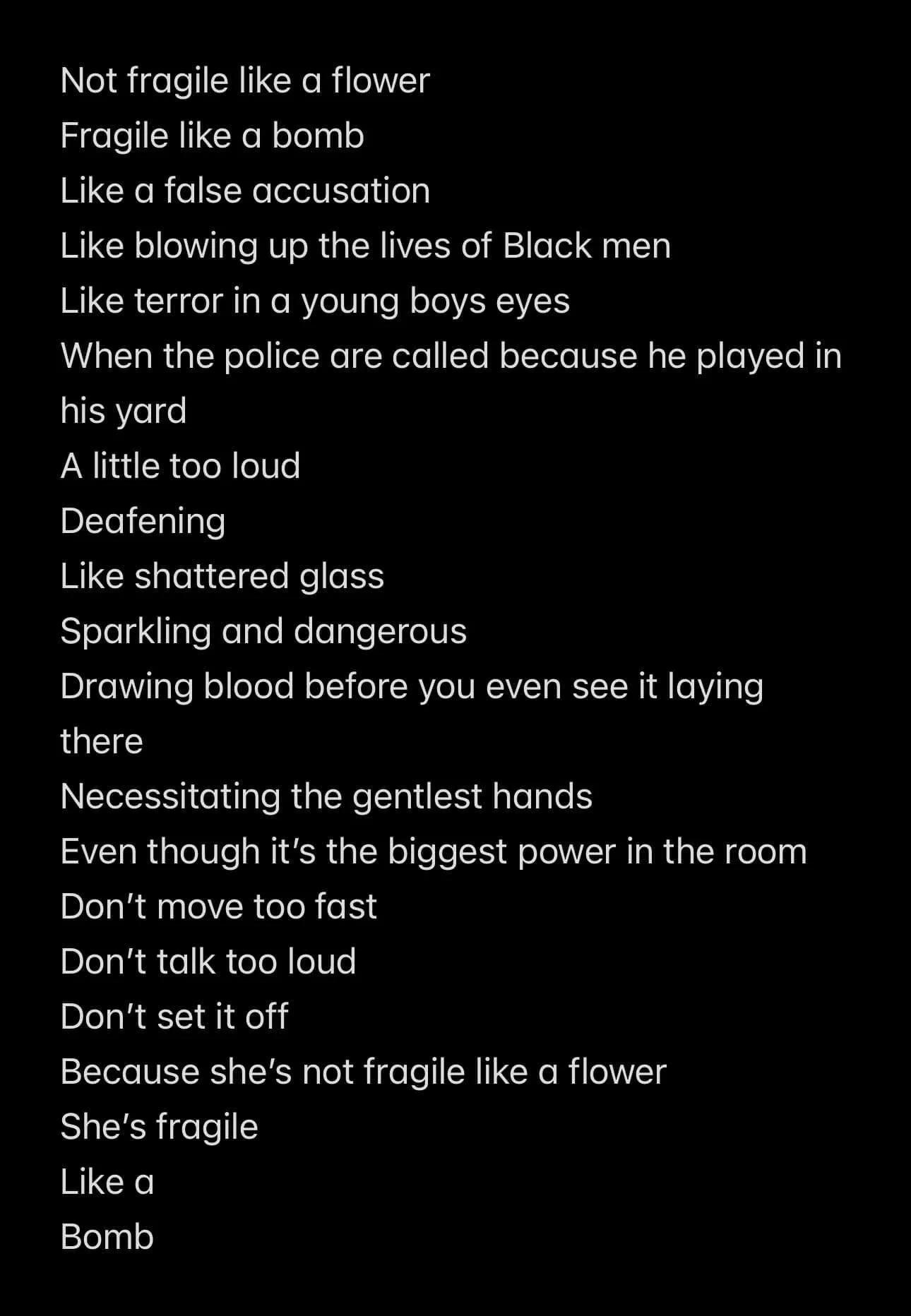
All the deaths of Black men, Black boys came rushing towards me. The Black women labeled angry, hostile, dangerous all to make white women “fragile”.
And what do they do with that fragility?
They “talk to managers” and get Black people fired from their jobs.
They take control of natural resources and keep BBA folks in the toxic wastes they create.
They create systems that encourage us to self police what we wear, how we talk, how we respond to the oppression we face.
They enact a 250 year genocide on Black people that we don’t even have the balls to call a genocide!
How does it survive so long if it’s so damn fragile?
The missing piece is the power. The fact that whiteness has positioned itself and the people it claims with the vast systemic, social, and violent power. That’s not fragile.
But the problem is, we don’t actually call bombs fragile. We call them explosive, we call them dangerous, we call them violent.
We acknowledge their power.
So why on earth are we sitting here calling whiteness and white people fragile?
If we can’t name it, we can’t tame it.
Ok, name it to tame it isn’t my favorite therapist-ism but it felt like it worked here.
The issue is, it’s the truth. The more that we seek to coddle whiteness the harder it is to disrupt and dismantle.
If it can hide it can survive.
And survive it has.
It’s survived for centuries, it’s survived when so many thousands haven’t survived it. That’s not fragile!
And it does so by adapting. It shifts and rolls, it lays in wait, it strikes down critique. It avoids even being named.
One of the biggest “critiques” (see: white tantrums) I receive and I see other Black women receive when we discuss, face down, and call out racism is that we should be softer, kinder, gentler when we do it. We should treat the person being racist as fragile so they might possible be open to listening to us, who they have harmed.
Half the time the expectation is that we seek to “educate” (and this is where we remember that educating is a job people have where they are trained and they get -poorly- paid to do it). This centers white learning as the responsibility of random BBA people who happen to get caught in the blast.
And when we name this dynamic is actively happening its brushed off and belittled.
I have heard that it’s a shame mechanism and that’s why it’s fragility. It’s an inner weakness that the term is naming, not a social one. But again, if that inner “weakness” exerts itself as power, it’s not fragile.
So I’m not calling it fragility.
I’ll call it what it is: a defense of power. A refusal to feel discomfort. A weapon that silences, harms, and kills.
White people are not fragile. They are protected. And that protection comes at a cost to Black, Brown, and Asian people (not to mention the earth).
Fragile things break. Bombs explode.
And they leave craters behind when they do.
And whiteness? It explodes into violence when threatened, whether that's a white woman calling the police, a white therapist pathologizing a Black client, or a white institution upholding policies that destroy Black lives.
So no. I won't call it fragility.
I'll call it what it is: a violent defense of a system that was built to destroy us.
I can imagine better.
I’ve been working a lot on practicing radical imagination. On thinking toward instead of just away.
So, what could we have if we moved on from “white fragility”.
We’ll I’m a realist at heart so I think we would start with a lot of angry white people doing angry white people shit.
But I think we could also see a rise in agency.
At the end of the day, calling it fragility is damn near gaslighting (a word I don’t use lightly). It keeps people holding the system of whiteness and the harm of racism with kid gloves. Without it, we can hold these things with what they deserve.
Disgust, anger, a fighting spirit.
Black, Brown, and Asian people could find it empowering to stop pretending that it’s so easy to break whiteness. Then, instead of worrying about breaking it, about the backlash, we could intentionally focus on doing so.
I imagine we could take further, stronger steps toward dismantling the systems if we named them properly.
I imagine we could actually center radicalized harm as an understanding of the survivors of it, not the perpetrators.